%3Aquality(90)&w=3840&q=75)
Battery system warranties are no longer static terms and conditions—they define financial performance, operational confidence, and long-term value. For Technical Asset Managers overseeing multi-vendor energy storage systems, warranty compliance often means juggling multiple datasets, supplier rules, and varying interpretations.
Cellect's Warranty Tracker was built to solve exactly that. It consolidates every warranty into one place, automatically tracks compliance across systems, and flags emerging issues before they impact operations—giving operators real-time visibility into key metrics, early warnings for potential risks, and unified access to product, availability, and performance warranties.
As battery portfolios grow, so does the data they generate. Warranty Tracker simplifies this complexity by automatically comparing guaranteed KPIs, such as State of Health (SoH), Usable Capacity, and Round-Trip Efficiency (RTE), against real performance values. When a deviation appears, the system alerts you immediately and forecasts potential breaches before they happen. Tracking BESS availability becomes easier than ever, removing hours of manual analysis at the end of each warranty period.
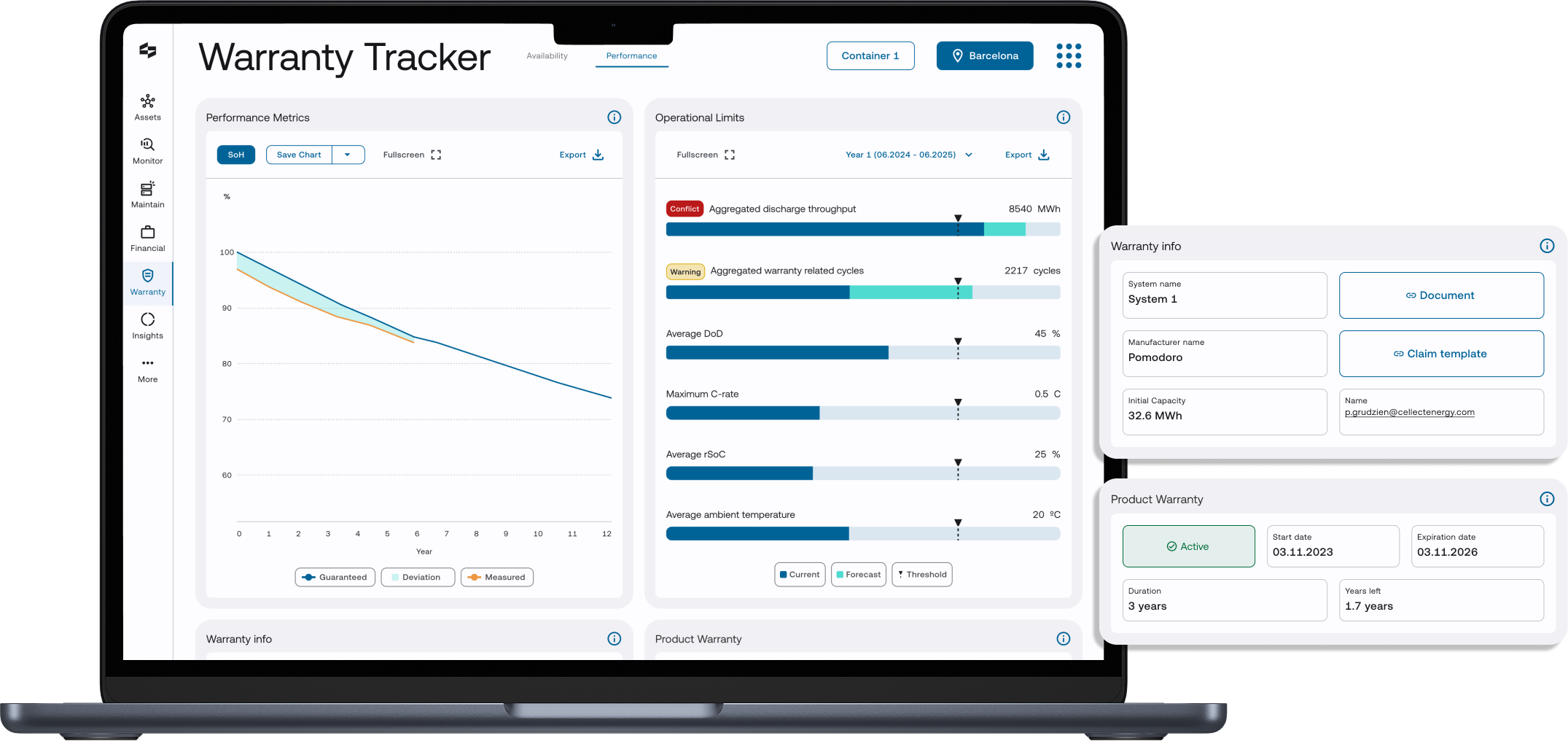
1. Performance warranty
Forecasts energy throughput and cycling trends to identify penalty risks early.
Alerts you when performance approaches operational limits.
Speeds up deviation detection between guaranteed and actual performance, providing evidence for warranty claims.
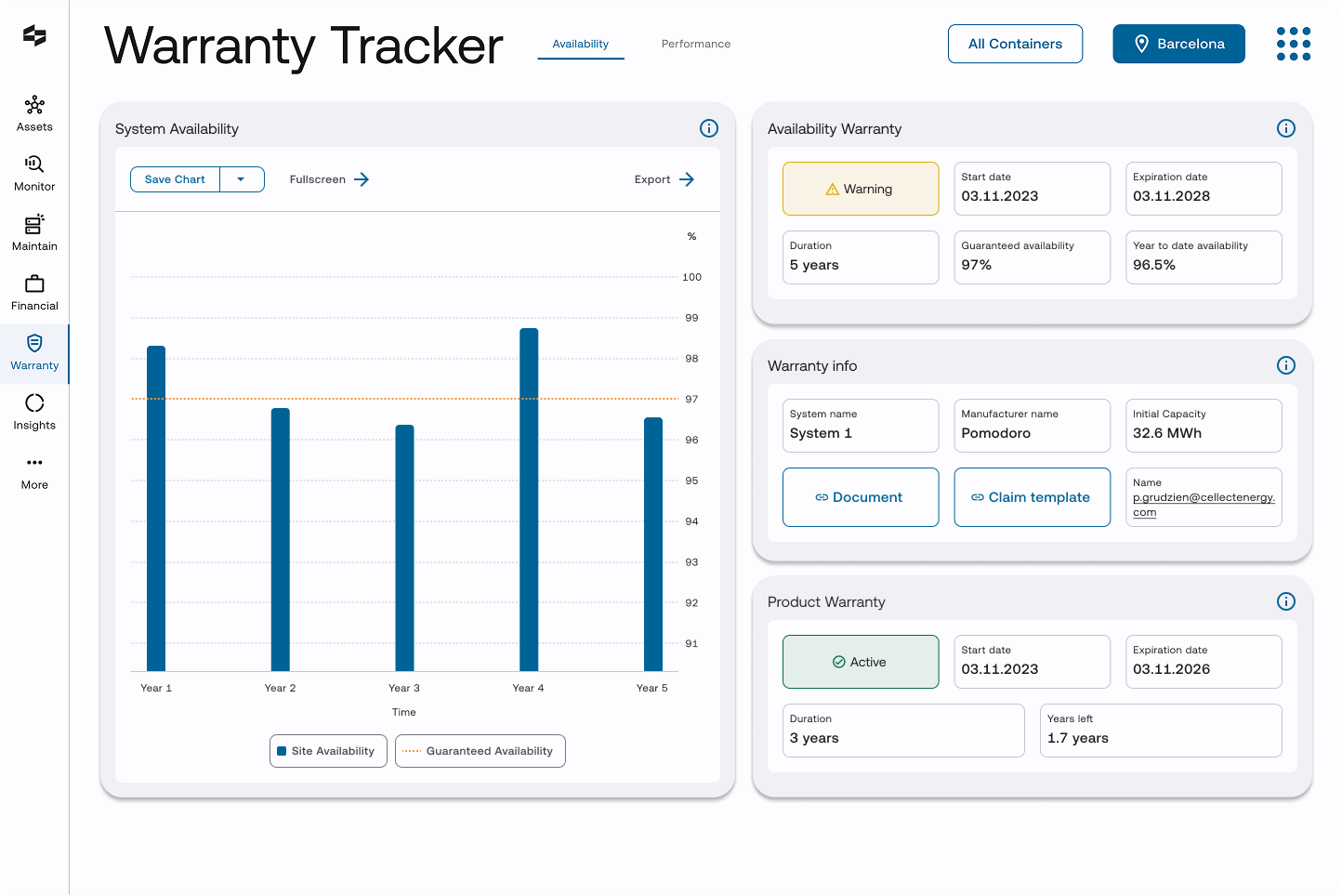
2. Availability warranty
Calculates asset availability using the methodology defined in your warranty contract.
Automatically flags availability below guaranteed thresholds.
Eliminates manual reconciliation across multiple suppliers.
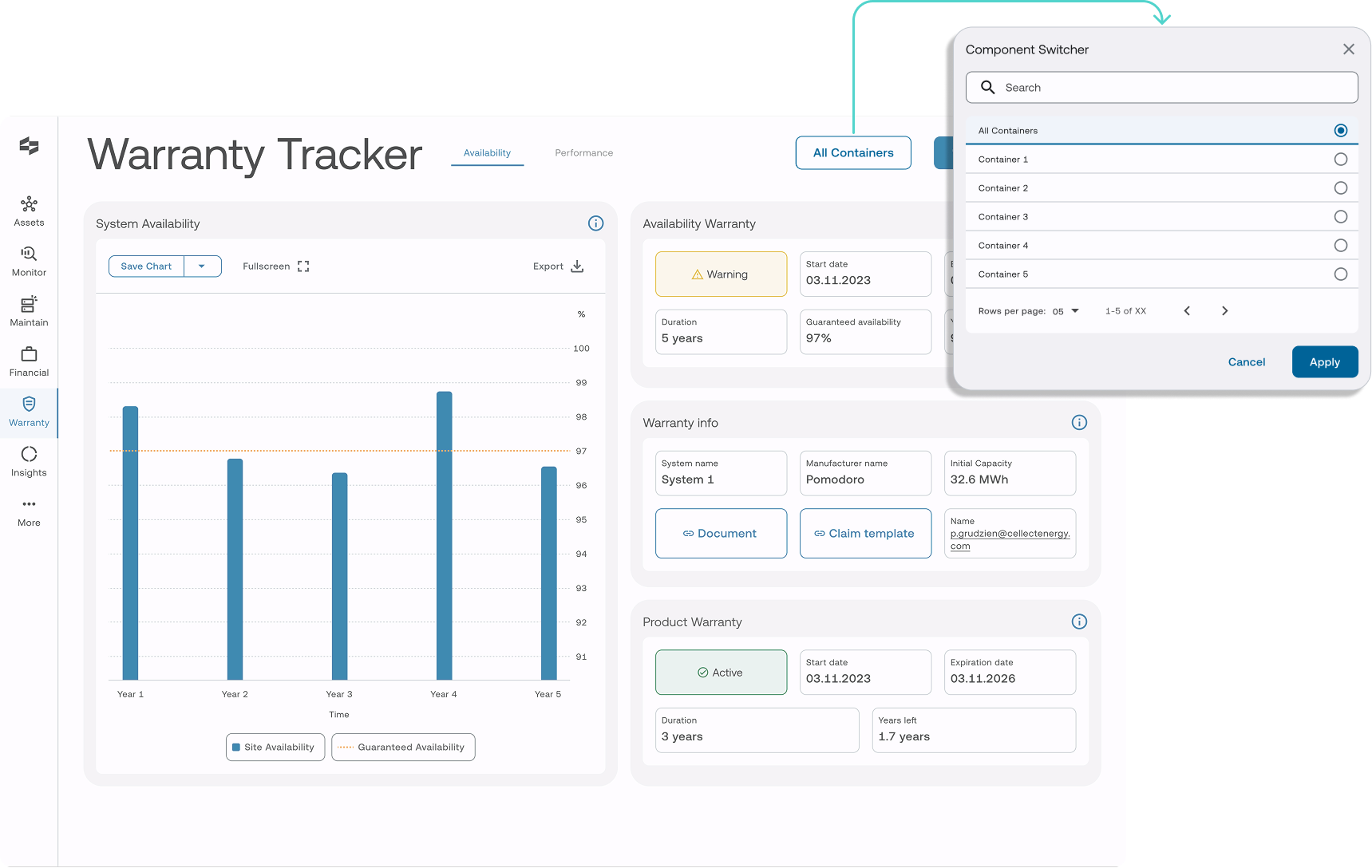
3. Component-level visibility
Navigate between containers or racks using the Component Switcher to track warranties at any level.
Compare component KPIs to identify underperformance.
Warranty Tracker helps teams quantify warranty risk and recover value that would otherwise go unclaimed.
Putting warranty cost in context
Performance warranties typically represent 1–4% of BESS CAPEX annually. With European utility-scale BESS CAPEX around €285/kWh for a 2-hour system (Reuters, 2025), companies invest significantly to protect their investments and ensure performance.
But buying a warranty is just the start. Each warranty comes with detailed operating conditions, exclusions, and calculation methods that teams must follow daily. In practice, this is challenging: contract terms are buried in legal documents, data sits across disconnected systems, and availability must be calculated exactly as defined to support claims and prevent revenue losses.
Warranty Tracker solves this by turning contract terms into operational tools. It centralizes warranty information, calculates key metrics using the contract methodology, and organizes the supporting evidence needed for warranty discussions and claims.
Guaranteed cycles: Understanding the cost of a warranty penalty
Our team has spent nearly a decade working with BESS operators and reviewing performance warranty terms across leading battery suppliers. One consistent finding is that even small breaches of warranty conditions can trigger penalties that lead to significant revenue losses over the asset’s lifetime.
A common scenario occurs when an OEM reduces the maximum energy throughput by a fixed number of cycles after a breach. Based on typical cycling profiles and average revenue levels observed in leading European storage markets, a reduction of 150 cycles spread over the remaining lifetime translates into an estimated revenue loss of approximately €4.1M for a 100 MW site.
Guaranteed availability: Capturing the compensation you're owed
Most battery storage contracts guarantee availability between 95–98%. In practice, availability is often lower. In ERCOT, one of the most established battery markets, reported availability has averaged around 93% since January 2021—falling short of typical contractual guarantees (Modo Energy).
When availability drops below the guaranteed threshold, battery owners are entitled to compensation. Without a systematic way to calculate availability using the contract's exact methodology and organize supporting evidence, these shortfalls can go unclaimed or disputed.
For a 100 MW site, a 2% annual availability shortfall represents roughly €240,000 in compensation.
Reducing the reporting burden
Availability warranty reporting is typically a manual, year-end exercise: exporting event logs, applying contract exclusions, accounting for partial availability, building spreadsheets, and preparing claim documentation. This workload multiplies when managing portfolios across multiple OEMs and data sources.
Warranty Tracker reduces that burden by calculating availability using the contract methodology and organizing all supporting evidence in one place. Teams can significantly cut reporting effort, simplify multi-site complexity, and scale operations without adding headcount or manual spreadsheet work.
Cellect's mission is to tackle the challenges of operating utility-scale energy storage by developing solutions that increase reliability, profitability, and support for the energy transition. Warranty Tracker embodies that mission—it transforms warranty terms into tools teams can use daily, reducing manual work, helping avoid preventable penalties, and keeping claim evidence organized.
To see how Warranty Tracker works across real portfolios, request a demo.
&w=64&q=75)
&w=3840&q=100)