%3Aquality(90)&w=3840&q=75)
The adoption of renewable energy across Europe has seen varying rates of progress, with one major bottleneck consistently slowing developments: land availability and permitting. When evaluating land as a constraint, two key factors must be distinguished:
The amount of land required. The larger the land footprint an energy project demands, the more challenging its development becomes—whether due to space limitations, high costs, environmental impact or community opposition.
Land regulations and classifications. Local policies and zoning laws play a critical role in determining whether a plot can host renewable energy assets. In many cases, regulatory restrictions prevent development altogether.
Different renewable energy technologies require vastly different land footprints, directly influencing their scalability and project timelines.
Wind Energy: Wind farms are highly dependent on specific site conditions, such as strong, consistent wind resources, which are geographically limited. They also require large areas to be technically and economically feasible. This scarcity of suitable land has increasingly pushed wind development offshore, where more expansive areas are available.
Photovoltaics (PV): Solar energy, on the other hand, is far more versatile in terms of location, as sunlight is widely available, albeit in varying intensities. However, PV systems often demand even more land than wind projects to generate the same energy output. This makes solar deployment particularly challenging in densely populated or land-scarce areas.
Enter Battery Energy Storage Systems (BESS), a game-changer in renewable energy deployment. Thanks to their compact design, BESS assets require only a fraction of the land footprint compared to wind or solar, making them an ideal solution for regions where space is at a premium.
To illustrate the efficiency of BESS, imagine a standard football field—roughly 1 hectare in size (100 m x 100 m). What kind of energy capacity could be deployed in that space?
With a PV plant, you’d achieve approximately 0.5 MWp of installed capacity.
However, using the same area for a BESS installation, with current configurations of 4 MWh per 20-ft container and a 2-hour system, you could deploy around 125 MW and 250 MWh.
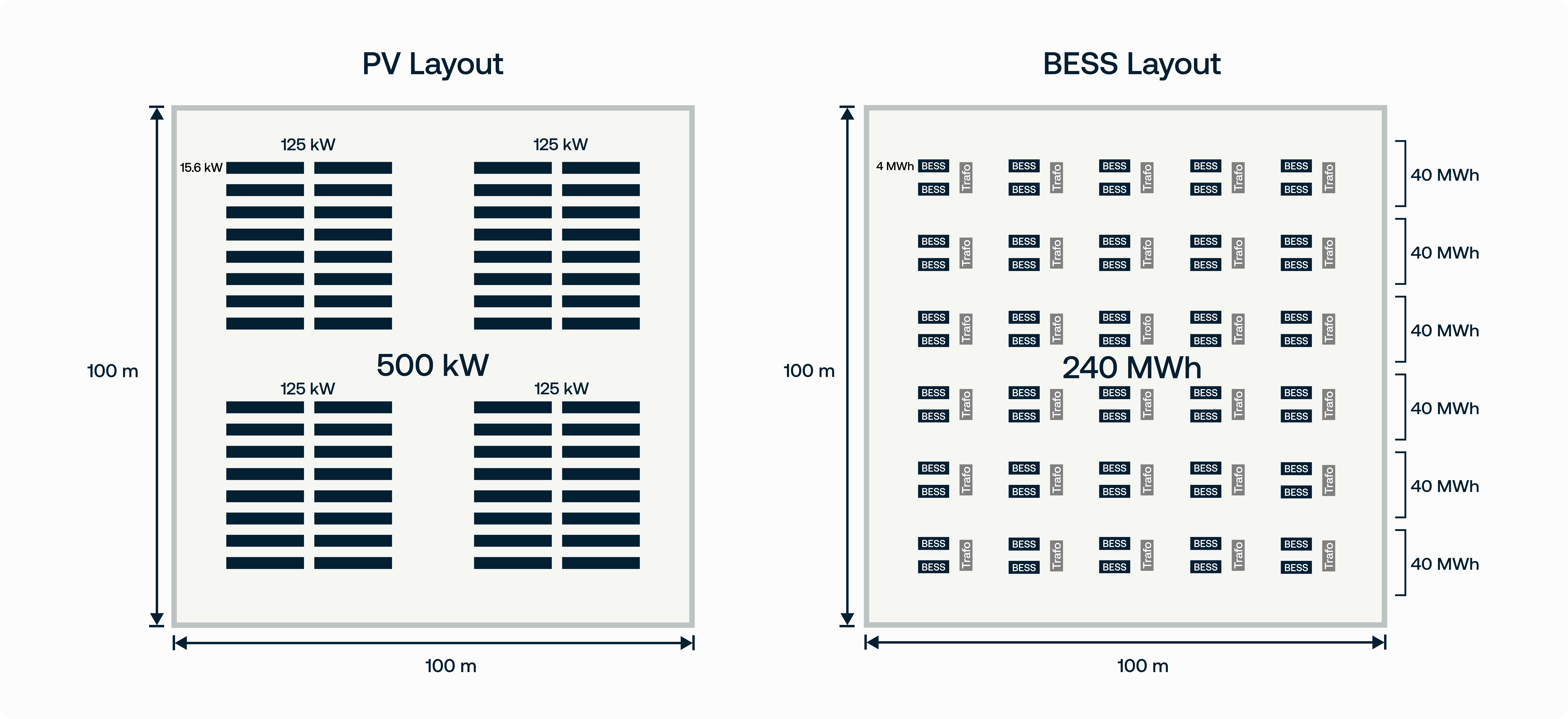
This stark contrast highlights the transformative potential of energy storage, particularly in regions where limited land availability has historically hindered wind or solar projects.
The minimal land requirements of BESS have created a clear trend: developers who launch their first BESS projects often scale up rapidly. Unlike PV and wind, where growth tends to follow a linear trajectory, the scalability of BESS is exponential.
The modular nature of BESS makes upscaling straightforward. Expanding from a 2-4 MWh pilot project to a commercial-scale +50 MWh system involves simply adding more BESS containers, Power Conversion Systems (PCS), transformers, and marginal additional land. This flexibility ensures that scaling is not only technically simple but also highly cost-efficient.
As land continues to pose a challenge for renewable energy deployment, BESS is emerging as a vital solution, offering high energy density in a compact footprint. With its scalability, adaptability, and efficiency, BESS is poised to accelerate the growth of renewable portfolios, reshaping the energy landscape and helping developers overcome long-standing barriers to progress.
Rapid scalability is one of the key advantages of energy storage systems like BESS (Battery Energy Storage Systems). However, this very trait can lead to regulatory hurdles that may slow down project timelines. Two notable examples of this are Germany and Spain, where specific regulatory thresholds significantly impact project development:
Germany’s KRITIS Regulation: In Germany, renewable energy assets surpassing certain size thresholds are classified as critical infrastructure under KRITIS regulations. This designation brings additional cybersecurity compliance requirements. Key thresholds include:
Originally set at 420 MW, the threshold was lowered to 104 MW in January 2022.
For assets participating in Frequency Containment Reserve (FCR) services—a critical and lucrative function for BESS in Germany—this limit drops further to 36 MW.
Any asset with Black Start capabilities is classified under KRITIS, regardless of capacity.
Spain’s Permitting Framework: Spain’s regulatory environment, as outlined in Article 53 of Law 24/2013, divides permitting processes based on capacity:
Projects under 50 MW fall under the jurisdiction of regional authorities, with permitting criteria varying by Autonomous Community.
Projects ≥50 MW are processed at the national level by the Spanish Ministry for the Ecological Transition, as they are deemed strategic infrastructure.
Historically, small-scale PV developers (2–10 MW) rarely encountered these regulatory thresholds due to the capital, land, and manpower needed for scaling up and building larger projects. However, the rapid scalability of BESS systems means that even smaller developers are now navigating these regulatory challenges.
While BESS systems require significantly less land than other renewable energy technologies, land classification remains a critical legal barrier. Whether a site is eligible for energy storage development depends on its official designation by local authorities.
After securing a suitable plot near an electrical substation, developers must enter an administrative permitting process. This is often where delays occur, as approval depends heavily on the land's classification for energy storage use.
To address these challenges, EU Directive 2023/2413 recommends that Member States designate BESS assets as Infrastructure of Overriding Public Interest to enable more favorable urban planning conditions.
Encouragingly, progress has already been made in Spain:
The Autonomous Community of Catalonia recently passed Decree-Law 12/2025, accelerating the processing of over 900 MW of stand-alone BESS projects. This legislation is expected to set a benchmark for other regions.
Just a week later, the Region of Murcia followed suit with Decree-Law 1/2025, signaling momentum for similar initiatives across Spain and potentially the broader EU.
As BESS portfolios expand at an unprecedented pace compared to other renewable technologies, it is essential for operators to establish a long-term asset management strategy early in the process. Scaling efficiently requires tailored solutions that address both technical and operational complexities.
At Cellect, we specialize in helping operators manage BESS portfolios of any size. From compliance to performance optimization, we handle the challenges so you can focus on growth.
Contact us today to learn how we can support your BESS portfolio strategy and ensure your assets are ready for the future.
&w=64&q=75)
&w=3840&q=100)